

Return to Blog
Homepage << Articles
How to Impress Your Nurse Practitioner Preceptor During Rotations
- by
- Aug 05, 2026
- Articles

You’ve probably already heard the standard advice for NP clinical rotations from your faculty and peers: show up early, don’t be on your phone, ask good questions, send a thank-you note to your nurse practitioner preceptor. (All are true, and all are important, by the way.)
Here’s the thing. Your clinical preceptor can be one of the most influential people in your entire NP education. They’re the ones deciding, in real time, how much responsibility to hand you, how many procedures you get to attempt, and, down the road, whether they’re comfortable writing you a strong letter of recommendation or offering you a job.
Your didactic courses teach you the theory, while your nurse practitioner preceptor decides how much of the actual practice you get to experience firsthand. That’s a big deal! This means the difference between a rotation where you mostly stand in the corner and one where you’re genuinely practicing under supervision often comes down to how you show up, day after day.
So let’s skip the basics you already know and get into the stuff that actually separates a good NP student from a memorable one. These are the lesser-known moves that rarely make it onto the standard “be professional” checklist that make nurse practitioner preceptors want go out of their way to teach you more, advocate for you, write you a glowing letter, or straight-up offer you a job when you graduate.
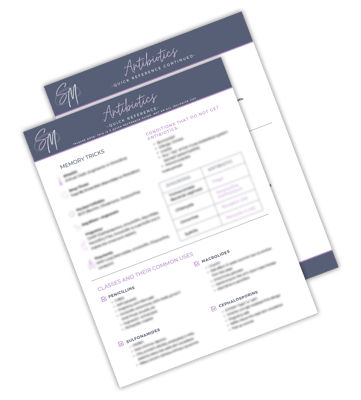
💊 FREE Download: Antibiotics Tip Sheet
Find memory tricks, antibiotic classes and their common uses, a common diagnosis and antibiotic chart, and other practical tips in this FREE Antibiotics Tip Sheet from SMNP Reviews!
How to Make a Great Impression on Your Nurse Practitioner Preceptor During Clinicals
1. Prepare like you’re the one seeing the patient.
Students who stand out prepare as if they are the ones walking into the room. That means knowing:
✅Why the patient is being seen today, specifically
✅Relevant past medical history and last visit’s plan
✅Pending labs, imaging, or referrals that need to be followed up on
✅A rough differential before you ever lay eyes on the patient
When your nurse practitioner preceptor asks, “So what do you think is going on?” and you already have a real answer, that’s the moment they start trusting you with more.
This one habit alone tends to shift how a preceptor sees you. Students who walk in unprepared each morning read as passengers along for the ride. Students who’ve already done the mental legwork read as someone actively building toward independent practice, which, at the end of the day, is exactly what this rotation is supposed to be preparing you for.
2. Present like an NP, not like nursing school.
Nursing school trained you to be thorough. Clinical rotations require you to be efficient. A lot of students default to reciting every detail of the H&P in chronological order, which is exhausting for a busy nurse practitioner preceptor to sit through between patients.
Instead, practice the “one-liner + assessment + plan” format:
“This is a 54-year-old male with a history of hypertension and type 2 diabetes presenting with three days of productive cough and low-grade fever. I think this is most consistent with acute bronchitis versus early pneumonia. My plan would be to auscultate lungs, check a pulse ox, and consider a chest X-ray if he’s hypoxic or has focal findings.”
Notice you’re not asking “what should I do?” but you’re stating what you would do and why. Preceptors can correct or refine a plan a lot more easily than they can extract one out of you.
3. Learn their documentation habits, not just the EHR.
Every experienced clinician has their own shorthand, macros, and personal style for notes (things that often aren’t written down anywhere).
Ask your preceptor directly: “Is there a note template or phrase style you prefer that I use?” This shows initiative and also makes their life easier when they’re co-signing your documentation, which matters more than you’d think when it comes to how much autonomy they hand you later in the rotation.
4. Ask about the “why not,” not just the “why.”
Most students ask why a preceptor chose a particular medication or treatment. Fewer students ask what else was on the table and why it was ruled out. That second question is where the real clinical reasoning lives, and it tends to genuinely impress nurse practitioner preceptors because it shows you’re thinking like a differential diagnostician, not just a checklist-follower.
Try: “What made you rule out [X] here?” instead of only “Why did you choose [Y]?”
5. Pick one skill to nail each day.
Instead of vaguely “trying to learn as much as possible,” walk in each day with a specific, narrow goal. For example, “Today, I’m going to get better at otoscopic exams. Tomorrow, cardiac auscultation to pick up murmurs. The next day, interpreting a CBC with diff.”
Tell your preceptor your goal for the day at the start of the clinical day. It gives them a reason to actively hand you those specific opportunities instead of just letting you observe passively, and it shows an intentionality most students don’t verbalize.
6. Befriend the front desk and the medical staff.
Nurse practitioner preceptors notice how you treat everyone else in the building, not just them. Medical assistants, nurses, and front desk staff often quietly report back on students who are rude, dismissive, or too “above” rooming a patient or helping restock a supply closet.
Being genuinely kind and helpful to the whole team is one of the most underrated ways to build your reputation at a site. And it often gets back to your preceptor faster than you’d expect!
7. Use downtime for chart review, not just flashcards.
It’s fine to study during true downtime, but if you really want to stand out, spend some of that time reviewing your preceptor’s charts from earlier that day or week.
Look for patterns: How do they typically manage a UTI in an elderly patient versus a young healthy one? How do they phrase patient education in their notes? This kind of self-directed pattern recognition shows initiative that flashcards can’t replicate, and it gives you smarter, more specific questions to ask later.
8. Ask for feedback during the rotation, not just at the end.
Most students wait for a formal evaluation to find out how they’re doing.
Ask earlier and more specifically: “Is there anything you’d like to see me do differently before our next few patients?”
Nurse practitioner preceptors are far more comfortable giving direct, useful feedback in the moment than in a final write-up, and asking mid-rotation signals that you actually want to grow, not just check a box.
9. Understand the business side, at least a little.
You don’t need to become a coding expert, but asking a thoughtful question about visit level, documentation requirements for billing, or how referrals get processed shows you understand that being an NP isn’t just clinical reasoning in a vacuum. Nurse practitioner preceptors who run or help manage a practice genuinely appreciate students who see the bigger operational picture.
Final Thoughts
None of these tips require you to be the smartest student your preceptor has ever had. Nurse practitioner preceptors have seen brilliant students who never got handed much responsibility because they never showed initiative, and they’ve seen average students who ended up running half the visit by the end of the rotation because they consistently showed up prepared, curious, and easy to work with.
What actually moves the needle is intentionality: being prepared, asking sharper questions (instead of just more questions), treating every person at the clinic like they matter, and asking for feedback before you’re forced to sit through a formal evaluation.
It’s also worth remembering that not every nurse practitioner preceptor is going to click with you the same way, and that’s okay. Some will be naturally more hands-off, some will want you to jump in from day one, and some will take a rotation or two to warm up before they start handing over more responsibility. Your job isn’t to force a specific outcome, but rather show up consistently as someone worth investing in, and let the relationship build from there.
Do that consistently across your rotations, and you won’t just impress your preceptors. You’ll walk away having actually built the real clinical instincts, the confidence, and the professional reputation you’ll rely on for the rest of your career as a nurse practitioner!
You’ve got this! Go be the real deal! (And if you need help with your NP board review at the end of the road, you know where to find us:)

Related Posts


Search the Blog
Prepping for Primary Care NP Boards?
Join our Primary Care Live Study Group or check out the Self-Paced Courses & Qbank options!
Learn MoreExplore Specialty NP Qbanks & Mock Exams
Practice with board-style questions for your AGACNP, PMHNP, ENP, WHNP, or PNP exams.
Get StartedJoin our Facebook Group!
Get FREE support and encouragement from thousands of FNP/AGPCNP students and our NP support team.
Join the CommunitySign Up for Free Live Classes
Join us for FREE monthly live study sessions covering topics such as antibiotics, diabetes, musculoskeletal conditions, depression & anxiety, and more!
Grab a Spot