Welcome to the Real Deal Nurse Practitioner Club, the podcast for nurses who are ready to pass their boards and thrive in their careers as real deal nurse practitioners. I’m Anna, and I’m the Director of Nursing Content at Blueprint Test Prep. Whether you’re deep in exam prep or stepping into practice, I’ve got you. It is time to become the confident, knowledgeable NP that you’re meant to be. Let’s dive in.
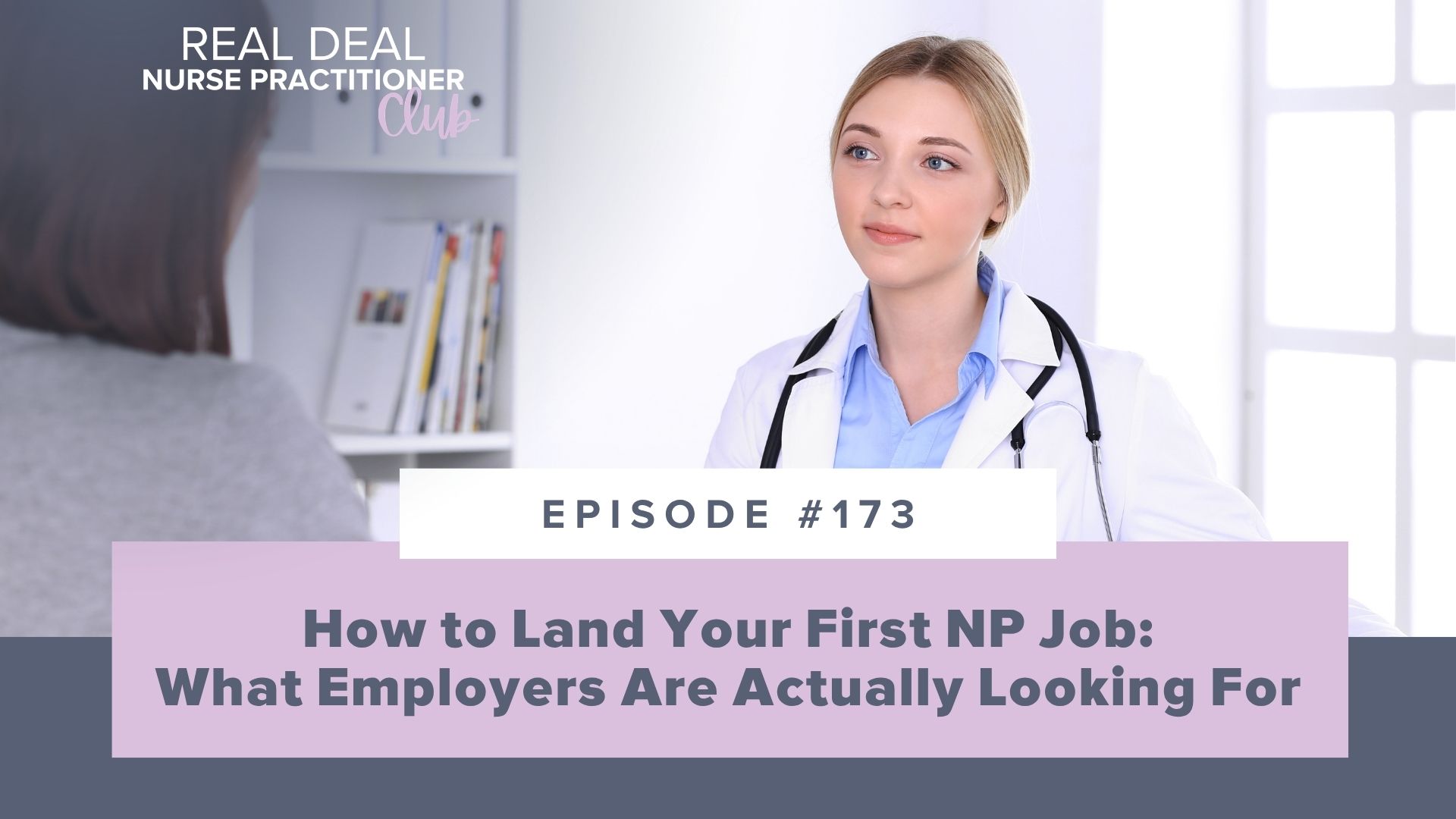
Hey, hey everyone, welcome back. It’s Anna here, and today we’re talking about something that comes right after passing boards, but honestly, for a lot of people, it can feel just as stressful as the exams. And that is getting your very first nurse practitioner job. Now, if you’ve ever caught yourself thinking, “Nobody wants to hire a new grad,” or “Every job requires experience,” or “How do I even begin to compete with applicants who have been practicing for years?” you’re not alone.
This is one of the most common conversations we have with new graduates after passing their exam. And while it’s true that transitioning into practice has some challenges, it can be a really big shift. I also think that there is a misconception that getting hired is mostly about luck. In reality, a lot of it comes down to how you present yourself, how you interview, and whether you demonstrate that you are ready to safely step into the NP role.
Today I want to walk through what employers are really looking for, some of the biggest mistakes that we see new grads make, and a few practical strategies that can help you stand out even if this is your very first NP position. And so I want to talk about something that I think changes everything, and that is that very first mindset shift. When you’re applying for NP jobs, you have to stop thinking like a student and you have to start presenting yourself like a clinician.
Now, before anyone panics, I’m not saying pretend you know everything. That would not be safe. And actually, employers expect you to be a new grad. They know that you’re going to need mentorship. They know you’re still learning, and they’re not expecting perfection. At least, any worthwhile employer hiring new grads is not. But everyone is expecting professionalism. They’re looking for someone who demonstrates good clinical judgment, who understands their scope of practice, who communicates well, and has the potential to grow into an excellent clinician. And that is a very different goal than trying to convince someone that you’re already an expert.
Let’s talk about resumes or CVs. I cannot tell you how many NP resumes all look exactly the same. They list the school, they list the degree, they list clinical rotations, and then they stop. And here’s the question I want you to ask yourself: if I removed the name of your clinical sites, would someone still know what kind of clinician you are becoming?
So instead of simply listing family practice clinical rotation, tell the employers what you actually did. Did you manage hypertension, diabetes, or asthma? Did you handle women’s health visits, perform pap smears, joint injections, skin biopsies, or suturing? Were you involved in chronic disease management, preventative care, patient education?
Really think about all the skills you’ve built, not just where you completed them, and see how you can tailor that to the job that you are applying for. Clinical rotations absolutely count as experience, so don’t undersell it.
And here is another practical tip for you: don’t make employers hunt for your credentials. Your license, your certification, your board eligibility if you haven’t tested yet, your BLS, your ACLS, if you already have your DEA, you can put that, and put those where they’re easy to see. Really think about it from the hiring manager’s perspective.
They are reviewing dozens, sometimes hundreds of applications, and the easier yours is to read, the better. You want it to be clean and organized and professional, and those little details, they matter a lot more than people realize. I look at resumes all the time when I’m hiring people here, and I cannot tell you the amount of times I have to even search if they’re a nurse, if they have any type of education experience, because it’s just buried or not clearly listed.
Now, another mistake I hear a lot of time during mock interviews is this sentence: “Well, I don’t have much real experience.” Please stop saying that. Because the interviewer already knows that you graduated a couple months ago, they are aware. When you lead with what you don’t have, you are unintentionally telling them why they shouldn’t hire you. Instead, talk about what you do bring. You bring current evidence-based practice. You bring recent clinical training. You bring enthusiasm, fresh knowledge, and a willingness to learn and adapt to their environment. Those are strengths. Own them.
And another thing that most applicants don’t realize, during an interview, the employer is usually trying to answer one big question: Can we safely train this person? They are not wondering, do they know every diagnosis? They’re not wondering, or they shouldn’t be wondering if you can practice independently tomorrow.
But they are trying to determine whether investing in you is a good decision. You do need to have some baseline knowledge, and then they need to see that you can think critically, that you can recognize your limits and practice safely. They want to know that you can ask questions when you need help. And can you communicate with patients? That’s another big one. They’re also looking at, you know, do you seem coachable? All of those qualities are incredibly valuable.
Most NP interviews are going to include at least a few clinical scenarios. And so here is one big piece of advice that will instantly make your answer stronger. Don’t jump straight to the diagnosis. Start with your assessment, right? Follow the nursing process. For example, instead of saying, “I’d diagnose pneumonia and I’d prescribe antibiotics,” start by saying, “First, I’d obtain a focus history, review vital signs, complete a thorough physical exam, and identify any red flags that would require emergency evaluation. From there, I’d develop my differential diagnosis and determine whether this patient could safely be managed in the outpatient setting.”
See the difference? That answer, and of course, tailor the content to whatever the clinical scenario is, but that is going to demonstrate your clinical reasoning, and that is what employers like to hear.
Now, you also need to know your scope. One of the most impressive things a new grad can say is, “This is something I feel comfortable managing independently, but if I encountered these red flags or if I encountered this level of complexity, I’d involve my collaborating physician or consult the appropriate specialist.” Now, that answer shows confidence and humility and safety. Knowing when to ask for help, it’s not a weakness. It is safe practice, and employers love hearing it when done right.
And of course, we’ve got to talk about confidence for a moment. Confidence does not mean acting like you know everything. Actually, that overconfidence is often a red flag. Real confidence kind of sounds like this: “Here’s how I would approach this patient,” or “Based on current guidelines, I’d begin with,” or “I’d reassess,” or “I’d consult if.” Now notice these statements, they’re not arrogant, they’re thoughtful, they’re organized, and they show clinical reasoning. Are you sensing a trend here?
And don’t forget that interviews, they go both ways. One thing I always encourage new grads to remember is that you are interviewing them too. Ask about onboarding, ask about mentorship, ask about how new grads are supported. How long does orientation last? Who are you going to be working with? Is there protected time for learning? Because the first job, it’s not just about getting hired. You need to find an environment where you can safely grow, and you really need a supportive first position to really shape your entire career.
Now, what if you’re not getting interviews? Maybe you’ve submitted dozens of applications and you haven’t heard back. Before assuming there are no jobs or that no one will hire new grads, take a step back. Have someone review your resume, update your cover letter, tailor your application to each position. Sometimes a few small improvements completely change the outcome. Remember, getting interviews and getting offers are skills, and just like clinical skills, they improve with practice.
And please, if you use AI to help you write or tweak your resume or your cover letter, please be sure to edit it. I cannot tell you how many times I come across application questions or resumes that still have the dialogue back and forth from ChatGPT in it.
Okay, let’s wrap up with a few key takeaways. Your first NP job isn’t about proving that you are the smartest, most ready, most experienced applicant. It’s about showing employers that you are prepared to become an excellent and safe clinician. Present yourself like a provider. Highlight your clinical experiences, not just your education. Talk about your strengths, demonstrate your clinical reasoning, know your scope and your limits, and show that you’re eager to learn. And remember, every experienced nurse practitioner was once a brand new graduate sitting exactly where you are today. No one starts with years of experience, and everyone has to start somewhere.
If you’re listening to this while studying for boards, polishing your resume, or maybe you’re currently filling out job applications, just know this: the healthcare system needs great nurse practitioners, and there is a place for you. It may take persistence. It may take several interviews. It’s going to take a lot of patience. But don’t let a few rejections convince you that you aren’t meant for this profession.
And don’t let that first year of being a new NP convince you that you aren’t meant for this profession either. It can be a tough transition going from RN to NP. But we’re going to keep improving, we’re going to keep applying, we’re going to keep learning, because your future patients, they’re not going to care how many applications you submitted or how many places you’ve interviewed. They really care that you have compassion, that you are knowledgeable, and that is exactly who you are becoming.
Thank you so much for joining me. If you are looking for more support as you transition into practice, definitely check out our board review courses. If you’re studying, we have our question bank, and all of the career content that we’re continuing to create here at SMNP Reviews on our podcast and on our YouTube channel. We are here to support you beyond boards and into your career as well. Until next time, take care, and remember, we are always rooting for you. You’ve got this.
Thanks for listening to another episode of the Real Deal Nurse Practitioner Club. If you want more information about the different types of support that we offer to students and new nurse practitioners, you can visit npreviews, with an S, dot com. We’ll see you next week.