Return to Blog
Homepage << Podcasts
Ep #145: How to Navigate Multiple NP Specialties with Kennedy
- by Sarah Michelle
- Aug 06, 2025
- Podcasts
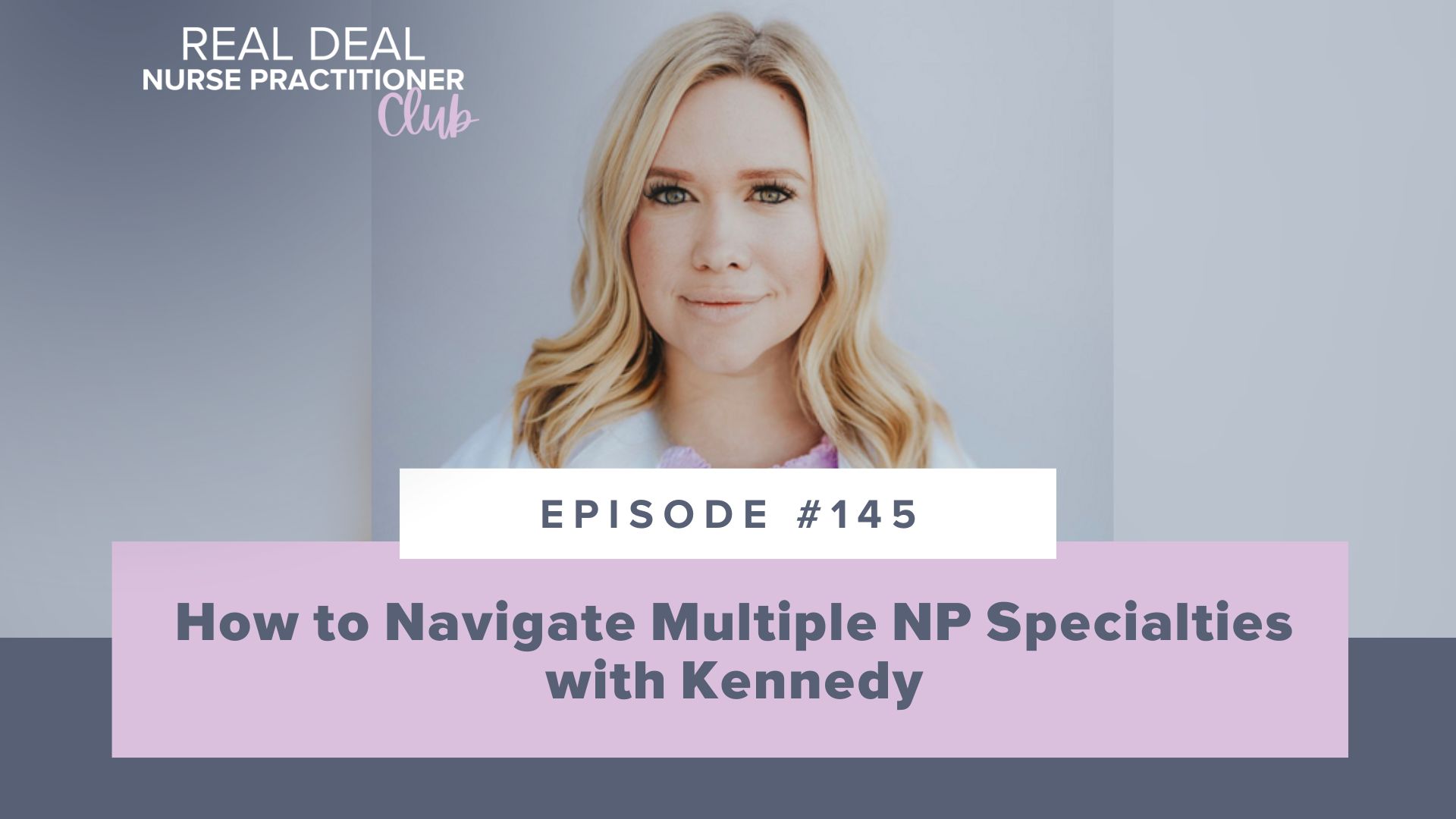
Are you struggling to find the right specialty as a new nurse practitioner? You’re not alone. In today’s episode, I sit down with my friend Kennedy to discuss her journey through multiple NP specialties – from endocrinology to telehealth and now transplant nephrology and aesthetics.
Kennedy offers valuable insights about transitioning between specialties, managing the isolation of telehealth work, and why new grads shouldn’t feel pressured to start in primary care. We also discuss specific strategies for succeeding in specialty roles and finding good work-life balance.
Tune in to hear how Kennedy’s experiences can guide you through the process of exploring different NP specialties and making informed decisions about your career path.
Liking the podcast? Join the fun and learn from our team of NP experts in our AANP & ANCC prep courses—with a 99%+ boards pass rate!
What You Will Discover:
– Why you shouldn’t be scared of starting in a specialty as a new grad NP.
– How to conduct effective telehealth assessments without physical exams.
– The signs of an unsupportive workplace you need to watch for.
– How to build confidence after transitioning into a new role.
Featured on the Show:
– UptoDate
– Podcast: Ep #99: Mental Health as a New NP
More Free Resources
– Blog Post: Telehealth NP Jobs: Tips to Get Hired & Succeed!
Full Episode Transcript:

Welcome to the Real Deal Nurse Practitioner Club, the podcast for nurses who are ready to pass their boards and thrive in their careers as real deal nurse practitioners. I’m Anna and I’m the Director of Nursing Content at Blueprint Test Prep. Whether you’re deep in exam prep or stepping into practice, I’ve got you. It is time to become the confident, knowledgeable NP that you’re meant to be. Let’s dive in.
Hey, hey, everyone. Welcome back to another episode of the Real Deal Nurse Practitioner Club podcast. I am so, so excited about this episode today. Today, I have my friend Kennedy here. She has been with SMNPReviews and Blueprint since nearly the beginning, and so I’m so excited that she gets to talk to you today about some of her experience. So Kennedy, do you want to just introduce yourself and give a little bit of your background as an NP?
Kennedy: Absolutely. Thanks for having me today. I’m so excited to talk about my experience as a nurse practitioner. Yeah, like you said, I’ve been practicing now for about 4 years, which is crazy to think about. I actually was looking today, and I took my boards March 25th of 2021.
So when I first came out of school, I focused, you know, endocrinology, and then I did telehealth for 2 years, and now I’m in transplant nephrology. So, I’ve kind of been everywhere, but it’s been good, and I’ve found my niche of where I want to be.
Anna: Yeah, that’s awesome. And I love that you mentioned, like, throughout the last 4 years, you’ve been so many different places and have been trying out different specialties in different areas to really find that because in your clinical rotations in NP school, you don’t get all these super cool experiences, right?
Sometimes you can do a specialty rotation or two, but you don’t get to experience all the possibilities that are out there with a primary care degree. And so sometimes it does just take a while to find that one area that you really thrive in and that you really want to stay in.
So, I know you mentioned you really kind of like this transplant area that you’re in, but I know a lot of our listeners are going to be interested in telehealth, especially that’s been such a growing area since COVID. So do you want to briefly talk about what it was like doing telehealth as an NP?
Kennedy: For sure. Yeah, absolutely. So, I did telehealth for about 2 years, like I said, and it was telehealth primary care.
It’s kind of a unique dynamic. So, we had a home provider who went into the homes to provide primary care, and then I was the telehealth provider who saw those patients via telehealth when needed for acute needs or for follow-ups.
I saw all different conditions, and also, these patients were really sick. A lot of the patients, it was home care or home primary care, I should say. So, they couldn’t leave their home, so you know, CHF, COPD. They had everything under the sun. And so, I really had to dive into my critical thinking because you’re not able to do a physical exam, right? It’s all via telehealth.
Like I said, I enjoyed it. And then at the end of it, when I decided to transition out of that role, it was mainly because you start to get lonely, right? So, when I was in a clinic setting, as I am now, and then was in endocrinology, you have your MA and your other APPs that you’re working with and the other doctors. And so, the reason I transitioned out was just because I needed that interaction, and it was getting kind of lonely being at home all by myself doing telehealth.
Anna: Yeah, I imagine that can feel very isolating, especially if you’re having any complex patients or just complex scenarios that you haven’t seen a ton and you need people to talk it through with or get a second opinion. That’s got to be a challenge in the telehealth setting, I imagine.
Kennedy: Oh, for sure. I mean, in endocrinology or even now in transplant, the other providers that I work with, they are just, I always say, a chair turn away because I can just turn my computer chair and I can bounce ideas off of them or ask them questions. And yeah, as you mentioned, with telehealth, I really had to critically think and dive headfirst and really try to use what they’re telling me, which you never know if they’re going to tell you everything and make the medical decisions.
Anna: Yeah, and you mentioned not being able to do, obviously, do a full physical assessment or anything because you are talking virtually with them. So how do you kind of navigate that of figuring out, okay, what does this patient need when I can’t do what I’ve been trained to do as a nurse for so long, which is like lay your hands on the patient and assess them?
Kennedy: Yeah, great question. So, I think it brings you back to school or prepping for boards, and I remember one thing that always goes through my mind when I’m doing telehealth is, this is silly, but also good because we learned it in school, is OLD CARTS and really using that and really trying to ask them, you know, questions that obviously you would in person, but you have to go a little bit deeper as well because, for instance, you know, many patients, they, “Well, how’s your blood pressure?” And they’ll say, “Oh, it’s good.” Well, what does good mean, you know?
And then the other thing is just using tools and resources that they have. So, I would always ask them, “Do you have a blood pressure cuff at home?” And typically about 75% of the time, they did. So, I’d say, “Okay, well, can you take your blood pressure and your heart rate and tell me what that shows you?” Or, “Do you have something to check your sugar?” And then that way, you know, they can provide me those vital signs at home, which made my visits a lot easier.
Anna: Yeah, you just got to get creative on how you get those answers you need.
Kennedy: Yes, absolutely. And then also, asking them if anyone lives with them because a lot of times these patients, right, they don’t live alone because they can’t leave their house. 9 times out of 10, they didn’t live alone. I shouldn’t say all of them. But also, you know, just asking, “Who do you live with?” And then if they say, “Oh, my daughter,” just asking, “Would it be okay if I spoke to your daughter?” Because a lot of times, family members will tell you more than the patient.
Anna: Yeah, I have found that to be true in the clinic setting, like in-person setting as well.Patients are so being like , “Oh, no, no, no, I’m fine.” And then they’re like, “No, you need X, Y, and Z, and this and this and this is going on.”
Kennedy: Right.
Anna: I know you’ve talked about endocrinology and transplant. And so for those who aren’t aware because those are very niche specialties, do you want to kind of talk about what’s included in working in those types of environments?
Kennedy: Yeah, so we’ll start with endocrinology. So, I loved endocrinology, and I really actually enjoy talking about this, especially with new nurse practitioners. Because I think it’s important to know, going into specialty out of school, a lot of people will say, “Well, maybe I should do primary care first.” And it’s totally okay to go into a specialty.
Endocrinology was great, and I saw a lot of diabetes, a lot of thyroid, and then on top of that, once you get into the diabetes, you’re also seeing hypertension, you’re also seeing hyperlipidemia. So, I always like to tell new grad nurse practitioners it’s totally okay to go into a specialty because 9 times out of 10, you’ll see all those other things that you’ll see in primary care. You may not see asthma, COPD as much, but you will definitely see a vast majority of things.
Anna: Yeah, I love that advice. I remember being back in nursing school, right, back in undergraduate, and they were always like, “You have to do med-surg. You got to start out in med-surg.” And I just knew med-surg was not for me, and I did start out as an RN in a specialty area, and I have done the majority of my career in women’s health. And that is where I knew I wanted to be, what I really liked, and I never felt like I was lacking in knowledge or lacking in anything.
You are still seeing a patient, and you are still seeing a whole patient. Just because you work in a specialty doesn’t mean we’re going to get tunnel vision and only focus in on one organ of their whole body. And so, don’t feel pressured if you just know something’s not for you.
Kennedy: And people often ask me, like, “Oh, well, if you love endocrinology,” because to this day, I will say I really thoroughly enjoy endocrinology. And I think this is another great point for new nurse practitioners, Anna, is I was seeing 21 to 23 patients a day, and I finally just said, “You know, this isn’t safe,” especially as a new grad, right? And I don’t have enough time to give the care to the patients that they need.
Also, I wasn’t having a good work-life balance. And so, although I loved it, I needed a change. And I think it’s important to know that going into an NP job is it’s okay to leave something and find something else for a better work-life balance, and you’re going to be happier. You’re going to enjoy your job more. And I think that’s just important to know because although I did love and I still do love endocrinology, finding that balance is so important, especially if you’re going to be somewhere long-term.
Anna: Absolutely. I love that advice. And you know, we’ve said that on here before. When you can prioritize your mental health and your boundaries and your work-life balance, you are going to be better able to serve your patients.
Kennedy: Exactly. Yes, I couldn’t agree with that more.
Anna: So now, how is that balance now that you’re working in transplant?
Kennedy: Transplant nephrology is great. So, it was definitely a learning curve for me. We talk about new grads a lot, but also seasoned nurse practitioners, you know, it was very hard because I went from my telehealth primary care to transplant nephrology, and I’m like, “Oh, I could do endocrine and primary care in my sleep.” And then you get thrown into this, and they don’t teach you transplant in school, right?
Anna: No, not at all.
Kennedy: So, at first, it was a little overwhelming. But it’s been great. So, I’m only in clinic in the mornings from 8 to 12. And I have an admin morning, so Tuesdays, I don’t go in at all.
Anna: Amazing.
Kennedy: I know, right? That admin morning just makes or breaks it.
Anna: I always recommend people negotiating for admin time built into their schedule.
Kennedy: Yeah. And then Tuesdays, Thursdays, I have 3 telehealth patients in the afternoon. And then Monday, Wednesday, Friday, actually, I have, it’s not admin time, we call it lab review time. So, these patients, because they have kidney transplants, they’re getting labs, you know, when they’re first out every week and then every 2 weeks. And so, we have lab review.
So, I say all of that, just to remind people, is when you’re applying for jobs and maybe you see something that says, “Oh, this job is from Monday to Friday, 8 to 5,” and maybe you’re like, “You know, that doesn’t really fit my schedule,” or “I want a telehealth day,” just apply because you never know what you’re going to get because my schedule, although it’s Monday through Friday, 8 to 5, it’s way more flexible, and I’m working from home half the time. So, it’s a really good schedule.
Anna: Yeah, that’s an excellent point. I always say that too. If it says it wants experience and you’re a new grad, apply anyways. And you never know until you get that interview and you get there and you start talking to them. These are the types of questions you want to be asking of, “What is the schedule like? Is there admin time? Can I factor that in? Do I have any flexibility of doing any telehealth?” And all of these things that they’re kind of hard to fit into every single job description.
Kennedy: Absolutely. I think it’s so important. And then two of our providers, they prefer to do telehealth, so they just have a telehealth day. And so, they enjoy that. So yeah, exactly what you were saying. It doesn’t hurt to ask and you never know.
Anna: You never know. Exactly. Outside of this really amazing work-life balance, which I’m so glad that you found, and remember, you all, do not settle, keep looking. Even if you accept a job and you’re getting experience, that doesn’t mean you have to stop looking if you still feel like that’s not right for you. But what else do you really enjoy about working in transplant nephrology?
Kennedy: Yeah, so I think the patients. I mean, it’s so rewarding, right? They’ve received a kidney, and you know, there’s 2 types of transplants. We have our deceased donors and our living donors, and it’s just seeing both sides of it.
With the living donors, it’s great because typically it’s a family member or a friend, and just the joy that’s there. And then the deceased donors, you know, our patients are just so very thankful because once you’re on dialysis, statistics show us that you pass away in about 5 years. But if you receive a kidney, deceased donor kidneys last on average about 10 years. So, we’re literally giving them life, which is just such an amazing feeling, and it just brings joy to work and going into work and loving what you do.
Anna: That’s amazing. And do you have any advice for our listeners because you’ve been a new grad, and you’ve also experienced navigating very different areas? I mean, we’ve talked about how we are lifelong learners as nurses, and so it is not uncommon for people to jump from specialty to specialty, and then you feel new, like you feel brand new again.
So do you have any advice for our listeners who are in that phase of it’s their first few weeks, first few months, and they’re just having a tough time because they feel like brand new, they’re not the expert anymore?
Kennedy: There’s a few things. So, first, just going back to the basics. So, we preach this all the time, right? When we’re taking boards, they want to make sure that you’re a safe provider. And that’s just knowing the basics. So, one, just going back to the basics, understanding, your lab values and your diagnoses and treatment plans. And then remembering that it’s also okay to, once you’re in practice, a lot of stuff you’re going to look up. So just remembering that you don’t need to know everything. I promise you that I use UpToDate every day.
And then the second thing I would say is, if you’re not understanding something, that’s totally okay. I think it’s so important to have a good relationship with your colleagues, and then also your supervising physician or your attending doctors. I ask them something every day, and they never make me feel less than, or dumb, or, you know, they treat me as if I am on the same level as them.
So, I think creating those relationships and being able to have an environment that it’s okay to ask questions. And I think when you’re looking for a job, I think that’s an important question as well, is, “What does the APP to MD or APP relationship look like and how do you guys collaborate in clinic or in the office?” Because that is so important.
Anna: Absolutely. And I just want you all to have that in the back of your mind that if you start working somewhere and it is an environment where you are not allowed to ask questions or you get looked down on or judged for not knowing everything, that is a red flag. You should be encouraged to be looking things up, to be learning.
Healthcare is always changing. Even very seasoned NPs are always asking questions and looking things up and refreshing on guidelines and learning new things. And so, if you’re in a role where they expect you to know it all and be completely independent without asking questions, that is a red flag.
Kennedy: Yes. And even a little tidbit here is, my attending doctors, they actually encourage us to ask questions. And even if they’re with a patient, I know, and I don’t feel bad, if I have to go knock on the door of whatever patient they’re seeing and ask them a question, they step out, obviously, but they would rather me do that than make a medical decision that I’m unsure of. They want me to be confident. They want me to ask questions. So, yeah, Anna, just like you said, that’s a huge red flag if you know they’re not open to that.
Anna: Yeah, especially when you’re brand new or you’re in a new area. Make sure you’re asking all the questions. Make sure you know your support systems. When it comes to, you know, these specialty roles, is there any other, you know, clinical skills you feel like are essential for success? Or is there any specific advice you have for people considering a job in an area like this?
Kennedy: One thing that I did to help me was I’ve attended some conferences and webinars in my specialties. So, just look out for what’s in your area or not in your area, you can take a trip. But attending conferences, webinars, you know, that will cover your specialty.
And then also just remembering to give yourself grace, right? It takes time and it’s okay. You’re going to feel new for a while and that’s okay. I’ll say with endocrine, I didn’t feel like I knew what I was doing until 6 months in. And then even then, I still had questions. I always have questions. So, give yourself grace and just know that eventually you will be comfortable and confident and always remind yourself that you’ll never know everything and that’s okay.
Anna: I love that. Yeah, you’re never going to know everything. You’re never going to know it all. You’re never expected to. You should never be expected to. Yeah, you’ve got to give yourself grace. Absolutely.
Now, very quickly, before we wrap up, I remember that you do some aesthetics NP stuff as well.
Kennedy: Yes, so I do work in aesthetics part-time. I really enjoy it, and it’s a great way for me to have kind of a fun NP job. So, these patients come in, you provide procedures that make them, you know, feel beautiful or make them more confident. And so, I love that aspect of it.
And it’s also kind of nice to have that. So, I probably only do it once or twice a month, but it’s also nice to have that and be practicing as an NP in that role, especially after I’ve had a tough week at work. So, if I’ve had to talk with patients about rejection about their kidneys, and then I get to go to my fun job and make people feel confident. If you love procedures and don’t want to give that up, I felt like that was really hard for me when I went from nurse to NP. This is a great way to kind of continue on with that and then, like I said, also have fun doing it.
Anna: Yeah, and that’s awesome that you can do it too on that part-time basis. And you make your own schedule and you can really balance the two because we talked about that work-life balance being so important. And so, that’s awesome that there are those types of side opportunities that if you all are interested in, I highly, highly encourage you to explore.
Kennedy: Yeah, I think having little side gigs is great. Eventually, say you get into it part-time. I know I’ve had some friends who get into it part-time, and they’ve just kind of built up their hours so much that they go full-time with it. And if you want that to happen, it definitely can. So, I encourage you to do it if that’s something you’re interested in.
Anna: You have all the side gigs. I love all the experience. You guys are fabulous teachers and instructors here. That just goes to show how many different things that you can do with this degree and how many different areas there are to explore.
So again, if you get into that first job and you’re not happy, I mean, you do have to consider that it’s a transition and it’s hard to be new. That 6 months is what I hear a lot, is that it takes a minimum of 6 months to start feeling comfortable. So definitely evaluate if it’s just that discomfort of being new again. But if it really is something that you’re not happy with, there are so many other opportunities out there.
Kennedy: Yeah, don’t let a job hold you hostage. And I mean that because I feel like as a nurse, we do that as well, like in the hospital setting. We get into these jobs, and we get comfortable.
And then the other thing is, I feel like there’s kind of a culture where we don’t want to let people down, so we don’t want to leave because we feel like we’re letting people down. You have to take care of yourself to take care of patients and also to live a life that you want to live and be happy and joyful and have a good work-life balance. So, I always tell people if you’re not happy, it’s okay to leave.
Anna: Yes. Tell yourself that it’s okay to say no. It’s okay to leave. It’s okay to put yourself first because ultimately, that is putting your patients and your future patients first as well.
Well, I think that just about wraps up this episode. So, Kennedy, thank you so much for coming on and sharing all about your experience. And as always, if you all have any other specialties you want us to cover and find people to interview on this podcast, definitely let us know. Follow us wherever you listen to podcasts, and we’ll see you next time.
Thanks for listening to another episode of the Real Deal Nurse Practitioner Club. If you want more information about the different types of support that we offer to students and new nurse practitioners, you can visit npreviews, with an S, dot com. We’ll see you next week.
Enjoy the Show?
- Don’t miss an episode: follow the podcast on Spotify, Apple Podcasts or RSS.
Related Posts

Search the Blog
Prepping for Primary Care NP Boards?
Join our Primary Care Live Study Group or check out the Self-Paced Courses & Qbank options!
Learn MoreExplore Specialty NP Qbanks & Mock Exams
Practice with board-style questions for your AGACNP, PMHNP, ENP, WHNP, or PNP exams.
Get StartedJoin our Facebook Group!
Get FREE support and encouragement from thousands of FNP/AGPCNP students and our NP support team.
Join the CommunitySign Up for Free Live Classes
Join us for FREE monthly live study sessions covering topics such as antibiotics, diabetes, musculoskeletal conditions, depression & anxiety, and more!
Grab a Spot