
Return to Blog
Homepage << Articles
Should You Use AI to Study for NP Boards?
- by
- Feb 25, 2026
- Articles

If you’re studying for NP boards right now, you’ve probably typed something into an AI tool at least once. Maybe you asked it to explain heart failure in simple terms…or even asked it to write practice questions.
You’re not alone!
Artificial intelligence is everywhere, and it’s natural to wonder whether it should be part of your board prep strategy. But the real question isn’t, “Is AI good or bad?”—it’s actually, “How can I use it so it helps me pass?”
In this post, we’ll talk about the pitfalls of AI for board prep, and then discuss ways to utilize AI that will actually benefit your studying. Let’s talk through it!
 FREE Download: 3 NP Study Hacks
Looking for some hacks for NP board prep? Here are our top three study tips to help you pass your NP board exam with flying colors! Just fill out the form below and have it sent straight to your inbox. 

The Temptation of AI
One of the most common ways students try to use AI is to generate practice questions. You type in “Write 20 NP board-style questions on diabetes management,” and seconds later you have a full set. That’s so efficient!
…right?
Pitfall #1: Accuracy Isn’t Guaranteed
Unlike human-crafted questions that are reviewed by experts for clinical accuracy and tested against exam blueprints, AI-generated practice questions can be inconsistent.
They might:
….include flawed clinical scenarios.
…contain distractors that don’t align with board-test logic.
…emphasize memorization rather than clinical reasoning.
The problem is that board-style questions aren’t just about content. The best NP board practice questions follow a specific structure, need to align with the published exam blueprint, and try to evaluate clinical reasoning patterns. They’re intentionally written to test how you think as a clinician.
Pitfall #2: Reinforcing Bad Habits
The next pitfall in AI for NP board prep is related to those poor quality questions. If you answer a bunch of AI-generated questions wrong or, if the questions themselves are poorly written, then you risk reinforcing the wrong clinical reasoning pathways.
Unlike vetted Qbanks where explanations are carefully developed by NP educators, free-form AI doesn’t come with quality control, relevant evidence citations, or correct blueprint alignment.
And if you accept what AI gives you without fact-checking against trusted sources (textbooks, evidence-based guidelines, instructor-created questions), you could be studying the wrong things without even knowing it. AI is great for generating ideas, but facts always need to be double-checked.
Pitfall #3: Learning vs. Shortcutting
Another pitfall is treating AI as a shortcut instead of an assistive tool. This can lead to:
…skipping foundational comprehension.
…relying on summaries without engaging deeply.
…missing why an answer is correct (not just that it is correct!).
NP board prep requires active engagement with the content. You need to answer questions, get some wrong, review the rationales, and reflect on why you missed them. That’s how clinical judgment develops.
If AI becomes a way to skip that process, it can actually slow your growth. Instead, look for ways for AI to support that process by clarifying confusing areas, organizing your weak topics, or helping you build memory aids.
How to Use AI Productively in NP Board Prep
Let’s get to the encouraging part!
AI is incredibly powerful when used intentionally. The key is to think of it as an assistant, not a replacement for high-quality board prep materials.
Tip #1: Organizing & Summarizing Notes
One of the best ways to use AI is for organization. If your notes are scattered across documents, screenshots, and scribbled margins, AI can help you turn that chaos into structure.
For example:
– Feed it your lecture slides and ask for a concise outline.
– Paste in a dense textbook explanation and ask for a simplified breakdown.
– Generate topic lists and mnemonics to help with long-term memory.
This kind of restructuring actually helps your brain to see patterns, connections, and frameworks more clearly.
Tip #2: Clarifying Tough Concepts
AI is also helpful when you’re stuck on a concept that just isn’t clicking. Maybe you understand hypertension management in theory, but you keep mixing up first-line choices in specific patient populations. Asking for a different explanation or a case-based breakdown can help you see the clinical reasoning more clearly.
And because AI responds instantly, you can ask follow-up questions until it makes sense.
Tip #3: Creating Personalized Study Tools
Another great tip for using AI is to help create personalized study tools for you. You can ask AI to create:
– Flashcards tied to your NP specialty
– Summaries based on difficult topics for you
– Personalized study schedules to keep you focused and organized
When you use AI like this, it becomes a study organizer rather than a question machine. These ideas support retention, pattern recognition, and efficiency without replacing the vetted, board-aligned questions that should anchor your preparation.
Have you Heard of Blue?
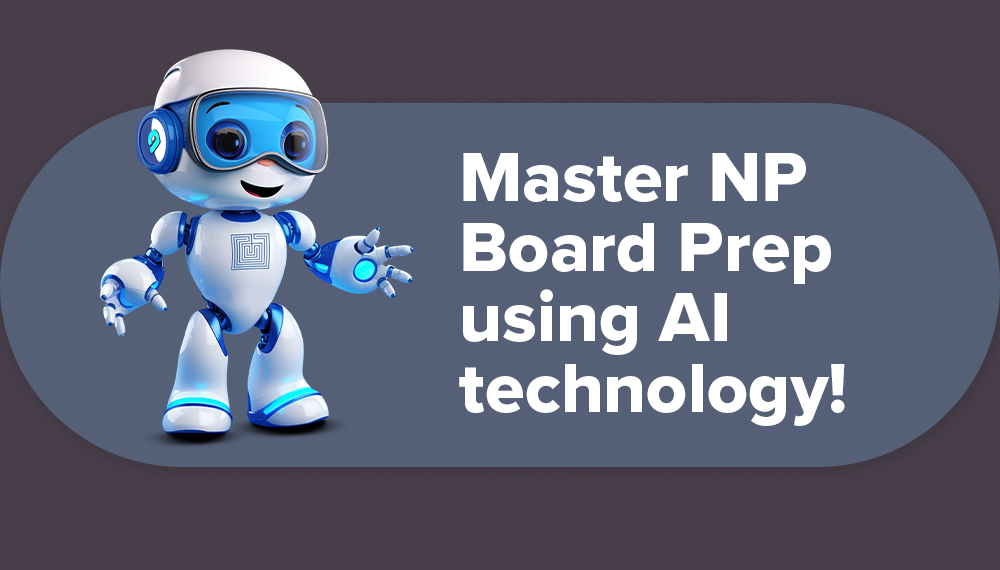
Here at SMNP Reviews, we have Blue, an AI tutor bot to elevate your board prep experience in your Primary Care Certification Exam Qbank!
Blue has been built to work alongside our carefully developed, blueprint-aligned board questions. Instead of replacing high-quality questions, it strengthens your interaction with them. Blue encourages you to think through the reasoning rather than just accepting an answer. Also, because it’s tied to actual Qbank items, you stay grounded in exam-relevant material.
When you’re reviewing a Qbank item and you don’t fully understand the rationale, asking Blue for help allows you to dig deeper. You can ask why a distractor is wrong, request a step-by-step breakdown of the clinical reasoning, or explore a related scenario without leaving the question environment.
While your practice questions still come from our experienced NP educators (and are aligned with board standards), Blue then enhances your understanding of that content.
Final Thoughts
AI isn’t the enemy of good board prep, but it also isn’t a magic solution. When used well, it can help you organize scattered notes, break down confusing concepts, create memory aids, and build structured study plans that keep you on track. It can act as a sounding board when you need a different explanation or a fresh way to look at a topic that just isn’t sticking.
Where you want to be cautious with AI is in replacing high-quality, board-aligned practice questions with randomly generated ones. NP board exams are carefully constructed to test clinical reasoning, prioritization, and safe decision-making, and your preparation should mirror that level of intentional design.
At the end of the day, boards are assessing whether you can think like a safe, competent nurse practitioner. So, approach AI with curiosity, not dependency! Pair it with vetted question banks like the ones here at SMNP Reviews. When you do that, AI becomes one more tool helping you walk into exam day feeling prepared and confident. 💜
Related Posts

Search the Blog
Prepping for Primary Care NP Boards?
Join our Primary Care Live Study Group or check out the Self-Paced Courses & Qbank options!
Learn MoreExplore Specialty NP Qbanks & Mock Exams
Practice with board-style questions for your AGACNP, PMHNP, ENP, WHNP, or PNP exams.
Get StartedJoin our Facebook Group!
Get FREE support and encouragement from thousands of FNP/AGPCNP students and our NP support team.
Join the CommunitySign Up for Free Live Classes
Join us for FREE monthly live study sessions covering topics such as antibiotics, diabetes, musculoskeletal conditions, depression & anxiety, and more!
Grab a Spot